

By Mason Sharpe, Esq. | Sharpe Properties | April 2026
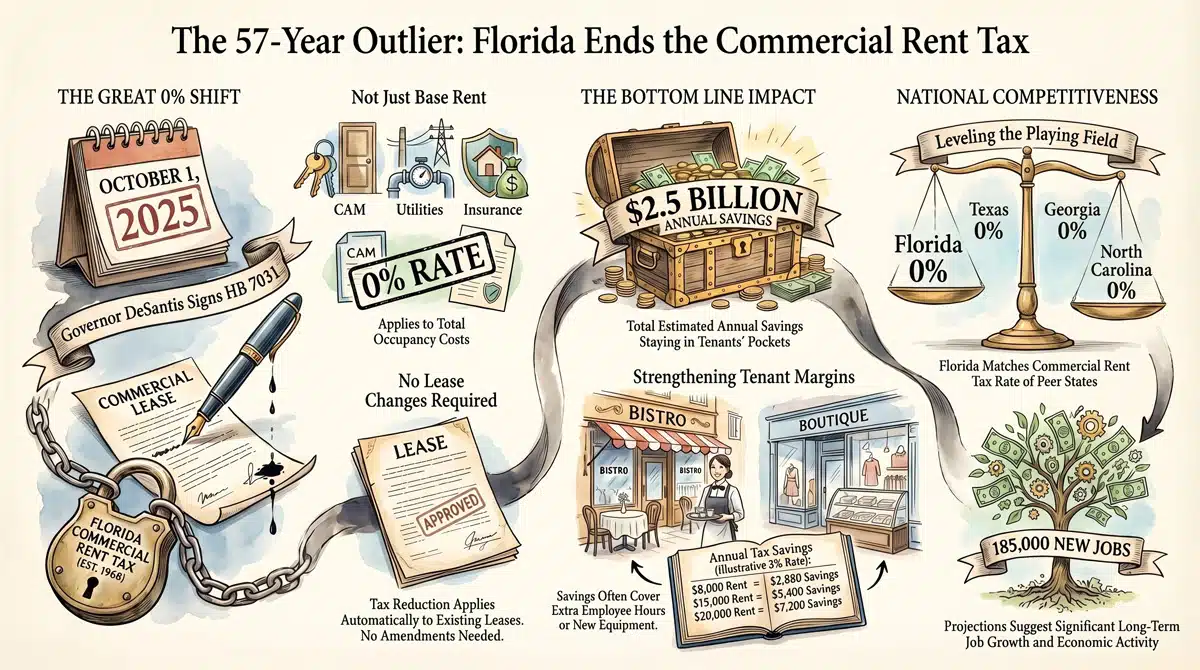
For 57 years, businesses renting commercial space in Florida paid a tax that no other state in the country charged. Not Texas. Not Georgia. Not North Carolina. Just Florida. That changed on October 1, 2025.
If you lease office space, a warehouse or retail space in South Florida, you’re now paying less, and nothing in your lease had to change to make that happen. The reduction is automatic. No renegotiation, no amendment, no paperwork.
What the Tax Actually Was
The tax lived in Florida Statutes Section 212.031. On paper, it was a sales tax on commercial leases. In practice, that meant every invoice you received from your landlord had a state sales tax applied on top of it.
And it wasn’t just the base rent line. The tax applied to common area maintenance charges, utilities billed through the lease, insurance contributions, and property tax pass-throughs. Every dollar on the invoice was taxable. Most tenants didn’t realize how broad the reach was.
That’s not normal. Most states don’t treat rent as a taxable transaction at all.
At its peak, the rate hit 6%. By the time it was eliminated, the state had reduced it to 2%, but most tenants in Miami-Dade were still paying a combined 3% once the local discretionary surtax was added in. Three percent on every dollar of every charge, every month.
How It Got Repealed, and Why It Took 57 Years
The bill that killed the tax was House Bill 7031. Governor DeSantis signed it on June 30, 2025, and it took effect October 1, 2025. The House passed it 93 to 7.
Getting there took much longer. The repeal effort traces back to 2010, when practitioners at a Miami REALTORS Commercial Board of Governors meeting realized Florida was losing business relocations directly to North Carolina. Not because of wages or workforce. Because of this one tax. North Carolina didn’t have one, and site selection consultants were using that fact against Florida in every competitive pitch.
That discovery launched nearly 15 years of sustained advocacy from Florida Realtors, NAIOP Florida, BOMA Florida, the Florida Chamber of Commerce, and the National Federation of Independent Business. The Legislature began phasing the rate down before eliminating it entirely:
- 5.5% through late 2023
- 4.5% starting December 1, 2023
- 2.0% starting June 1, 2024
- 0% starting October 1, 2025
Governor DeSantis, on signing HB 7031: “Florida was the only state charging a tax on commercial leases. By eliminating this tax on the rent businesses pay for their operations, we are helping keep Florida a competitive place to start and grow a business.”
Florida Chamber of Commerce President Mark Wilson: “By Florida eliminating the business rent tax, it’s going to lower the cost of doing business in Florida, which will help lower the cost of living here.” (Source)
Florida was 1 of 50 states. The only one doing this. Now it isn’t.
What Tenants Are Actually Saving
The savings aren’t theoretical. Using a 3% combined rate (2% state + 1% Miami-Dade local surtax) as the baseline, here’s what the elimination means in real dollars:
| Monthly Total Occupancy Cost | Annual Tax Savings | 5-Year Savings |
|---|---|---|
| $5,000 / month | $1,800 / year | $9,000 |
| $8,000 / month | $2,880 / year | $14,400 |
| $15,000 / month | $5,400 / year | $27,000 |

Remember: those figures are based on your total monthly occupancy cost, not just the base rent line. If your invoice shows $10,000 in base rent and $2,500 in CAM, utilities, and insurance, the old tax was calculated on $12,500. The savings are bigger than most tenants initially assumed.
Statewide, Florida Realtors estimates that commercial tenants are saving $2.5 billion annually. A 2013 study by Fishkind and Associates (commissioned by Florida Realtors) projected that eliminating the tax would generate 185,000 new jobs and $20 billion in economic activity over time. Those are long-range projections, but the individual savings are immediate and real.
What Tenants Are Doing With the Savings
For most businesses, this isn’t a windfall they’ll pocket. It’s capital that goes right back into operations. A tenant saving $2,880 a year on an $8,000/month lease has options that weren’t available before.
That’s a part-time employee’s monthly hours. A new piece of equipment that’s been on the wish list for two years. A marketing push for a slow season. A small inventory build for a product line that’s been limited by cash flow.
None of those things sound dramatic in isolation, but they compound. A retail tenant who can afford better signage attracts more foot traffic. A warehouse operator who can add a forklift handles more volume. A small office that can hire a part-time coordinator gets more done. The tax savings don’t change a business overnight, but they give it more room to grow.
That’s why the framing of this change matters. It’s not just a tax cut. It’s a reduction in the friction cost of operating a business in Florida.
The Part Landlords Don’t Usually Talk About
I want to say something that doesn’t always get said in commercial real estate: good landlords want their tenants to succeed. That’s not just a nice sentiment. It’s how the math works.
A tenant who’s financially stretched is a tenant who falls behind on rent, asks for concessions, or leaves when the lease expires. A tenant operating with healthy margins sticks around, takes care of their space, and often wants more of it. Vacancy is expensive. Turnover is expensive. Keeping a good tenant who’s growing their business is not.
“My revenue didn’t change on October 1, 2025. I collect exactly what I was always owed. But my tenants keep more of their money.”
The state was collecting that 3% from businesses through their landlords. Landlords were the middlemen, collecting it and remitting it to Tallahassee. Now that money stays with the tenant. No one in this transaction is worse off except the state, and the state made a deliberate judgment that the economic activity generated by not taxing commercial rent would more than compensate.
For my retail tenants running restaurants, salons, or specialty shops with tight margins, a few hundred dollars a month matters. That’s real money. And a stronger tenant makes for a more stable property. I’m glad the law finally caught up to that logic.
What This Means for the South Florida Market
South Florida was already a strong market for business relocation before this change. Population growth, no state income tax, and an international business community were already working in our favor.
The one argument competing states used against us is now gone. Texas has no commercial rent tax. Neither does Georgia. Neither does North Carolina. For years, site selection consultants told companies considering Florida to factor in this added cost. That conversation is over. Florida is now on level footing with every one of those states on this specific issue.
For the local commercial real estate market, the repeal reduces effective occupancy costs without requiring any change to rental rates. A GlobeSt analysis noted that eliminating the tax would spark increased leasing activity and reinforce Florida’s reputation as a top destination for corporate relocations. Out-of-state businesses that were comparing Florida to other Sun Belt markets now have one fewer reason to choose somewhere else.
Practical Notes for Tenants and Landlords
If you’re in an existing lease, you saw automatic savings starting October 1, 2025. No amendment was needed, and no action was required. Your landlord should have stopped collecting the tax on that date. If you’re not sure, check your October 2025 invoice and any statements after that. If the tax line is still appearing, that’s an error worth correcting.
For leases being negotiated or renewed now, the tax line item simply shouldn’t exist. This also makes CAM reconciliation cleaner at year-end, because the additional rent items were taxable under the old structure, and that layer of math is gone.
One clarification worth making: your savings are based on your total invoiced amount, not just the base rent line. Tenants who only look at the rent number when estimating their savings are undercounting. Pull your last invoice from before October 1, 2025, add up every line, and apply 3% (or your specific combined local rate) to get the accurate figure.
A Final Thought
As a Florida-licensed attorney and a commercial property owner in South Florida, I’ve seen how lease economics affect whether a small business survives its early years or builds into something that lasts. A few hundred dollars a month matters when you’re running a distribution operation, a retail store, or a restaurant with real overhead.
Florida made the right call here. It took 57 years, but the logic was sound from the start: lower the friction cost of operating a business in Florida, and businesses do more operating here. That’s good for tenants, good for landlords, and good for the state’s economy.
If you have questions about how this change affects your current lease, or if you’re looking for warehouse or retail space in South Florida, feel free to reach out. We’re happy to walk through the numbers with you.
Sources & Further Reading
- Florida HB 7031 (Full Bill Text)
- Florida Statutes Section 212.031 (Pre-Repeal)
- Florida Realtors: Florida Ends 57-Year Tax on Commercial Leases
- NAIOP Florida: Applauds Elimination of Business Rent Tax
- BOMA Florida: Ends Nation’s Final Statewide Business Rent Tax
- Florida Chamber of Commerce: Business Rent Tax Repeal
- NFIB: Florida’s Small Businesses Victorious
- GlobeSt: Florida Ends Tax on Commercial Rent
- Governor DeSantis on X (@GovRonDeSantis)
Mason Sharpe is a Florida-licensed attorney and Vice President of Property Management and Leasing at Sharpe Properties, a family-owned South Florida commercial real estate company owning and managing industrial and retail properties across Miami-Dade and Broward Counties.
This article is for informational purposes only and does not constitute legal advice. Consult your attorney or tax advisor regarding the application of these changes to your specific lease.
Informacion en Espanol:
Florida Elimino el Impuesto sobre el Alquiler Comercial
Por 57 anos, los negocios que alquilaban espacio comercial en Florida pagaban un impuesto que ningun otro estado del pais cobraba. Eso cambio el 1 de octubre de 2025. Y lo mejor de todo: no fue necesario cambiar ni una sola clausula en su contrato de arrendamiento. La reduccion es automatica.
Que era el impuesto
El impuesto estaba establecido en la Seccion 212.031 de los Estatutos de Florida. Se aplicaba no solo a la renta base, sino tambien a los cargos de mantenimiento de areas comunes, servicios publicos, seguros y contribuciones de impuestos sobre la propiedad. En Miami-Dade, la tasa combinada (estatal mas local) llegaba al 3%.
Por que se elimino
El proyecto de ley HB 7031, firmado por el Gobernador DeSantis el 30 de junio de 2025 y vigente desde el 1 de octubre de 2025, elimino el impuesto completamente. Florida era el unico estado en el pais que cobraba este impuesto. Texas, Georgia y Carolina del Norte nunca lo tuvieron.
Cuanto se ahorra
Un negocio que paga $8,000 al mes en costos totales de ocupacion ahorra $2,880 al ano. En un contrato de 5 anos, eso es $14,400 que se quedan en el negocio. El ahorro aplica sobre el total de la factura del arrendador, incluyendo todos los cargos adicionales, no solo la renta base.
Ese dinero puede ir a horas de empleados, equipo nuevo, o campanas de mercadeo. No es un cambio dramatico de un dia para otro, pero si reduce la friccion de operar un negocio en Florida.
La perspectiva del arrendador
Mis ingresos no cambiaron el 1 de octubre de 2025. Cobro exactamente lo que siempre se me debia segun el contrato. Pero mis inquilinos retienen mas dinero. Un inquilino financieramente solido es un mejor inquilino, y eso beneficia a todos.
Si tiene preguntas sobre como este cambio afecta su contrato de arrendamiento, o si esta buscando espacio comercial o industrial en el sur de Florida, contactenos en Sharpe Properties. Con gusto revisamos los numeros con usted.
Frequently Asked Questions
Does the Florida commercial rent tax repeal apply to existing leases?
Yes. The repeal took effect automatically on October 1, 2025 for all commercial leases in Florida. No lease amendment or tenant action was required.
What was the Florida commercial rent tax rate in Miami-Dade County?
Most Miami-Dade tenants paid a combined 3%: the 2% state rate under F.S. Section 212.031 plus the 1% Miami-Dade local discretionary surtax.
Did the tax apply to CAM charges and additional rent?
Yes. The tax applied to base rent and all additional rent items billed through the lease, including common area maintenance, utilities, insurance contributions, and property tax pass-throughs.
What is HB 7031?
House Bill 7031 is the Florida legislation signed by Governor DeSantis on June 30, 2025 that eliminated the state sales tax on commercial leases, effective October 1, 2025.

Join The Discussion