

By Mason Sharpe, Esq. | Sharpe Properties | April 2026
If you own commercial property in South Florida and you have ever had to evict a tenant, there is a good chance someone along the way mentioned the “24-hour notice.” Maybe it was your attorney. Maybe it was the sheriff’s office. Maybe you read it somewhere and assumed it applied to your situation.
It does not. Not in a Florida commercial eviction.
Two Different Statutes, Two Different Rules
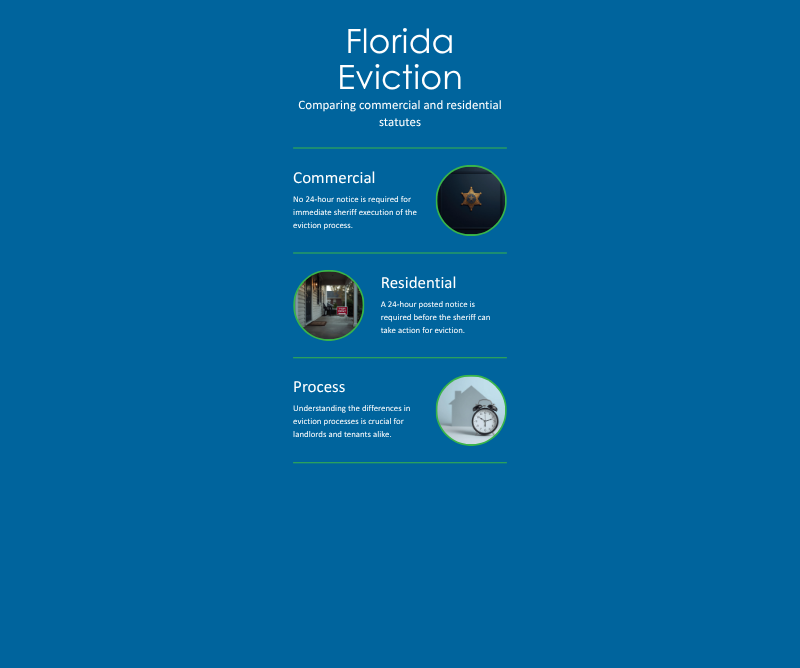
Florida’s landlord-tenant law is split into two parts under Chapter 83 of the Florida Statutes. Part I covers nonresidential (commercial) tenancies. Part II covers residential tenancies. They look similar on the surface, but on the question of the writ of possession, they operate very differently.
Here is the residential rule. Florida Statute §83.62(1) states:
| Fla. Stat. §83.62(1) — Residential Tenancies (Part II) “In an action for possession, after entry of judgment in favor of the landlord, the clerk shall issue a writ to the sheriff describing the premises and commanding the sheriff to put the landlord in possession after 24 hours’ notice conspicuously posted on the premises. Saturdays, Sundays, and legal holidays do not stay the 24-hour notice period.” |
Now compare that to the commercial statute, §83.241:
| Fla. Stat. §83.241 — Nonresidential / Commercial Tenancies (Part I) “After entry of judgment in favor of plaintiff the clerk shall issue a writ to the sheriff describing the premises and commanding the sheriff to put plaintiff in possession.” |
That is it. No 24-hour notice. No posting requirement. In a Florida commercial eviction, the sheriff is authorized to execute the writ of possession immediately upon receiving it.
The Problem in Practice
Most sheriff’s offices handle residential evictions the vast majority of the time. Their staff is conditioned to the 24-hour posting procedure. So when a commercial writ of possession arrives, it often gets processed the same way as a residential one. The deputy posts it, leaves, and returns the next day.
That extra day is not required by law. But it becomes the practical outcome when the writ does not make the distinction obvious.
Consider what a commercial tenant can do with 24 hours of advance notice in a Miami-Dade or Broward County warehouse or industrial space. That is enough time to move inventory, remove equipment, and complicate the recovery of the premises. For commercial landlords, this is not merely an inconvenience. It can cause measurable financial harm.
This is not a rare problem. It comes up regularly because the residential procedure is so deeply ingrained. Even experienced eviction attorneys who concentrate on residential work can overlook the distinction.
The Fix Is Simple
When your attorney drafts the proposed writ of possession for a commercial eviction under §83.241, the writ itself should make the distinction unambiguous. Put it somewhere the executing officer will see it immediately. Language like the following works well:
| Suggested Language for the Commercial Writ of Possession COMMERCIAL EVICTION — NONRESIDENTIAL TENANCY Florida Statute §83.241 applies. No 24-hour posted notice is required prior to execution. Sheriff is authorized to execute immediately upon receipt. |
It is not complicated language. But without it, you are relying on the sheriff’s office to recognize the difference between a commercial and residential writ of possession. In Miami-Dade and Broward Counties, that distinction is frequently missed. Deputies follow the residential process by default because it is what they handle every day.
If you are retaining an attorney to handle a commercial eviction who primarily practices in the residential space, ask directly whether the writ language addresses this. The distinction is easy to overlook, and the cost of missing it falls on the landlord.
The Bigger Point
The 24-hour notice rule is one of the clearest illustrations of how Florida’s commercial and residential landlord-tenant laws diverge. Part I and Part II of Chapter 83 are written for different legal relationships. Residential tenants carry statutory protections that commercial tenants do not receive. But commercial landlords also hold rights that residential landlords do not. The right to immediate writ execution without posted notice is one of them.
Getting this right does not require extensive effort. It requires knowing which statute governs your tenancy, and making sure your writ of possession reflects it.
Legal Disclaimer: This article is for general informational purposes only and does not constitute legal advice. No attorney-client relationship is created by reading this article. Laws may change. Consult a qualified Florida-licensed attorney for advice specific to your situation.
Citations: Fla. Stat. §83.62(1) (2025) — Restoration of Possession to Landlord (Residential) | Fla. Stat. §83.241 (2025) — Removal of Tenant; Process (Nonresidential/Commercial)


Join The Discussion